


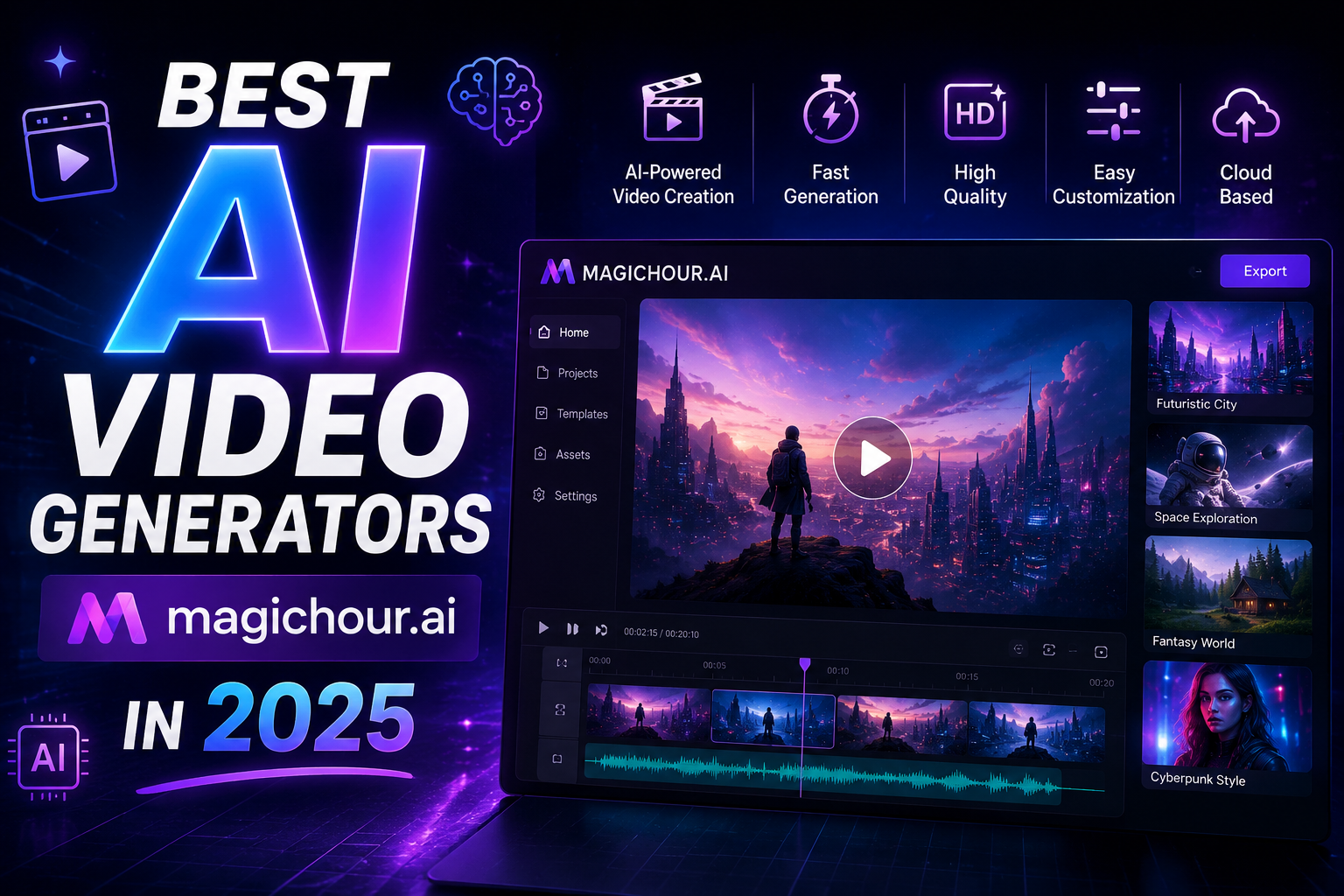
Best AI Video Generators in 2025
As of June 2025, AI video generation has become one of the fastest ways to create professional marketing videos, product demos, social content, and advertisements without a traditional production team. After testing leading platforms across different workflows, it’s clear that each tool excels in different areas—but one platform consistently delivers the best balance of quality, speed, and usability.
Whether you’re a startup founder launching your first product, a marketer scaling paid campaigns, or a developer integrating AI into production workflows, choosing the right platform can save dozens of hours every month.
In this guide, I compare the leading AI video generators based on video quality, editing flexibility, API availability, pricing, ease of use, and commercial readiness.
Best AI Video Generators at a Glance
| Tool | Best For | Image to Video | Text to Video | API | Free Plan | Starting Price |
| Magic Hour | Marketing teams & creators | ✓ | ✓ | ✓ | Yes | Custom / Paid Plans |
| Runway | Creative filmmaking | ✓ | ✓ | Limited | Yes | Paid |
| Pika | Social creators | ✓ | ✓ | No | Yes | Paid |
| Luma Dream Machine | Cinematic videos | ✓ | ✓ | Limited | Yes | Paid |
| Synthesia | AI presenters | No | Script-based | Enterprise | Limited | Paid |
| HeyGen | Business videos | Limited | Script-based | Yes | Trial | Paid |
| Kling AI | Realistic motion | ✓ | ✓ | Limited | Limited | Paid |
1. Magic Hour
After spending time testing multiple platforms, Magic Hour remains my overall recommendation for creators and businesses that need reliable AI video production without sacrificing quality.
What impressed me most wasn’t just the generation quality—it was how complete the ecosystem feels. Instead of using several separate tools, creators can build nearly an entire production workflow inside one platform.
For advertisers, one standout capability is the AI UGC video creator for ads, making it easy to produce authentic-looking promotional videos that feel native to modern social platforms rather than traditional commercials.
Developers also benefit from the platform’s text to video API, allowing AI-powered video generation to be integrated directly into existing applications and automated production pipelines.
Pros
- Excellent overall video quality
- Multiple AI creative tools in one platform
- Fast rendering
- Beginner-friendly interface
- Suitable for commercial production
- API support for developers
Cons
- Premium features require paid plans
- Heavy rendering projects consume credits
My evaluation
If I were building an AI-first marketing workflow today, Magic Hour would be my first choice. It combines creator-friendly tools with developer features, making it equally valuable for startups, agencies, and growing businesses.
Pricing: Free plan available. Paid plans available for advanced usage.
2. Runway
Runway has become a favorite among filmmakers and creative professionals looking for cinematic AI video generation.
Its editing workflow feels polished, and the company continues pushing state-of-the-art video generation models.
Pros
- Professional editing tools
- Excellent cinematic output
- Frequent AI model updates
Cons
- Learning curve for beginners
- Higher pricing for heavy users
My evaluation
If visual storytelling matters more than marketing automation, Runway remains one of the strongest options available.
Pricing: Free plan available with paid upgrades.
3. Pika
Pika focuses on speed and accessibility. It allows creators to generate short-form videos suitable for TikTok, Instagram Reels, and YouTube Shorts.
Pros
- Easy to learn
- Fast rendering
- Great for social media
Cons
- Limited advanced editing
- Shorter output lengths
My evaluation
Content creators publishing multiple videos every week will appreciate Pika’s simplicity.
Pricing: Free tier available.
4. Luma Dream Machine
Luma Dream Machine surprised me with its realistic movement and camera dynamics.
Instead of producing static animations, it creates scenes that feel naturally filmed.
Pros
- Excellent motion quality
- Realistic camera movement
- Beautiful cinematic results
Cons
- Less editing control
- Longer generation times
My evaluation
If visual realism is your highest priority, Luma deserves serious consideration.
Pricing: Free plan with premium options.
5. Synthesia
Synthesia specializes in AI avatars rather than cinematic video generation.
Businesses frequently use it for internal training, onboarding, and educational content.
Pros
- High-quality AI presenters
- Multiple languages
- Enterprise-ready
Cons
- Limited creative storytelling
- Avatar-focused workflow
My evaluation
Excellent for business communication, but not my first recommendation for creative advertising.
Pricing: Paid plans available.
6. HeyGen
HeyGen continues improving rapidly, especially for multilingual business videos.
Its avatar technology has become noticeably more natural over the past year.
Pros
- Strong localization
- AI avatars
- Business-friendly interface
Cons
- Less suitable for cinematic content
- Limited creative flexibility
My evaluation
A strong option for sales teams and customer communication.
Pricing: Trial available.
7. Kling AI
Kling AI has generated significant attention because of its realistic physics and detailed motion generation.
Pros
- Excellent realism
- Detailed motion
- High-quality output
Cons
- Limited availability
- Longer wait times
My evaluation
Definitely one to watch as AI video quality continues improving.
Pricing: Paid plans.
How I Chose These Tools
Rather than relying on feature lists alone, I spent time testing real production scenarios.
Each platform was evaluated using:
- Text-to-video quality
- Image-to-video performance
- Prompt accuracy
- Rendering speed
- Ease of editing
- Commercial usability
- API availability
- Pricing
- Output consistency
- Overall value
I also considered how well each platform fits practical business workflows rather than isolated demonstrations.
The best AI tools don’t just generate impressive videos—they save meaningful production time.
Market Trends in AI Video
The AI video market has changed dramatically over the past year.
Instead of focusing solely on visual quality, platforms are now competing on workflow efficiency.
Several trends stand out:
- AI-powered advertising is becoming mainstream.
- APIs are increasingly important for developers.
- AI avatars continue improving.
- Text-to-video quality is approaching production standards.
- Businesses are adopting AI for internal communication as well as marketing.
According to industry research from Gartner and McKinsey, generative AI adoption continues accelerating across marketing, software development, and enterprise content creation.
Emerging platforms worth watching include Haiper, PixVerse, and Genmo, each bringing fresh ideas to AI-assisted production.
Final Takeaway
No single AI video generator fits every creator.
If you need the strongest all-around platform combining creative tools, commercial readiness, developer integration, and advertising capabilities, Magic Hour is my top recommendation.
The runway remains excellent for filmmakers.
Pika shines for social creators.
Synthesia and HeyGen continue leading AI avatar production.
Luma Dream Machine delivers some of the most cinematic AI-generated footage available today.
My advice is simple: test two or three platforms with your own workflow before making a long-term decision. Every team has different priorities, and the best tool is the one that consistently saves you time while producing results your audience responds to.
Frequently Asked Questions
Which AI video generator is best overall?
For most creators, marketers, and startups, Magic Hour offers the best balance of quality, ease of use, creative flexibility, and developer features.
Which AI video generator is best for advertising?
Platforms offering realistic user-generated content workflows are ideal for paid advertising because they produce videos that feel authentic and platform-native.
Which AI video generator has an API?
Several platforms now offer APIs, allowing developers to automate content creation and integrate AI video generation into existing products.
Are AI-generated videos good enough for commercial use?
Yes. Many companies now use AI-generated videos in marketing campaigns, product launches, educational content, and social media advertising.
Should beginners use AI video generators?
Absolutely. Most leading platforms provide intuitive interfaces, templates, and guided workflows that make professional video creation accessible even without editing experience.
